The Clash of Legitimacies by Gamberini Andrea;
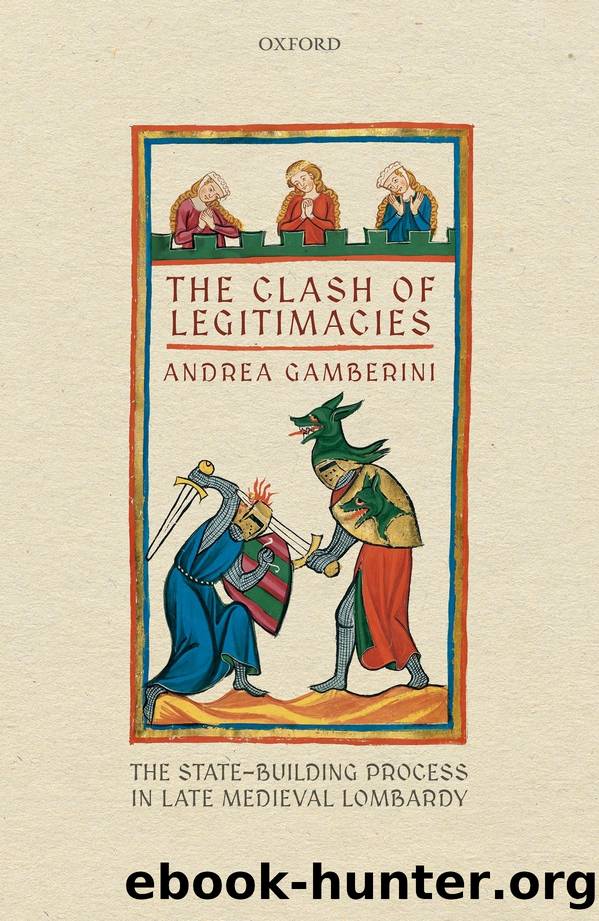
Author:Gamberini, Andrea; [Gamberini, Andrea]
Language: eng
Format: epub
Publisher: Oxford University Press USA - OSO
Published: 2018-09-08T00:00:00+00:00
4.1 Law as a Legislative Instrument
From the 1330s, the Viscontiâs attempt to intervene in local laws has been documented, as they tried to impose uniformity âon matters of political and general interest (criminal matters, tax matters, and so forth)â.15 Their activity was actually as far-reaching as it was often lacking in coordination, proceeding at different speeds and with different intensity in the various centres involved. And yet, the early appeal to the arbitrium âsuper bono et pacifico statu civitatisâ made it possible for the lords not only to amend or abolish, all or in part, the statutes of the subject cities, but also to subordinate their validity to the absence of opposing lordly decrees. The revisions promoted by Gian Galeazzo and then by Francesco Sforza were famous, perhaps more for the general scope of the intervention than for its depth.16
Indeed, lordly edicts became more and more numerous over the course of time, to the point of creating the impression of an âalluvialâ production, capable of creating a kind of ius commune of the state by a process of sedimentation, at least where certain matters were concerned.17
In reality, this process was a much more casual one than certain subsequent collections (such as the Novae constitutiones Mediolanensis dominii of Charles V, or the Antiqua ducum Mediolani decreta) might have us believe.18 Resistance was strong, above all, when the interventions of the lords threatened the very essence of civilitas, in the sense of a set of rights and traditions that made the communal political space an exclusive circle and the cives a privileged social group, giving rise to a lengthy struggle that not infrequently ended with the retraction of the lordly ius novum.
In fact, the ViscontiâSforza state remained a political construction largely indebted to its urban framework, something that differentiated it from the principalities that were taking shape over the same decades elsewhere in Europe.19 The cities continued to be important (though not the only) pillars of the new institutional architecture. They were also the cornerstone of a districtual geography that, though repeatedly fragmented by ducal feoffment and the concession to certain towns of privileges of jurisdictional separation, remained as vital as ever.20 The city statute thus continued to represent territorial law for most of the contado, while the urban court generally maintained its primacy over the most important civil and criminal cases. It was, of course, perfectly natural that jurists, bound as they were by a host of links to the urban world, opposed the measures that most endangered this heritage of local traditions and rights.
This was the situationâin many respects an exemplary oneâwith the reform of the civil process, which for almost fifty years was a source of conflict between the dynasty and the judges of the citiesâ colleges. From the earliest days of the signoria, the Visconti were concerned to deploy their influence throughout one of the crucial sectors for the life of subject communities, the area of justice. If the nomination of the podestà , appointed by the dominus, made
Download
This site does not store any files on its server. We only index and link to content provided by other sites. Please contact the content providers to delete copyright contents if any and email us, we'll remove relevant links or contents immediately.
| Anthropology | Archaeology |
| Philosophy | Politics & Government |
| Social Sciences | Sociology |
| Women's Studies |
The Secret History by Donna Tartt(19480)
The Social Justice Warrior Handbook by Lisa De Pasquale(12301)
Thirteen Reasons Why by Jay Asher(9135)
This Is How You Lose Her by Junot Diaz(7062)
Weapons of Math Destruction by Cathy O'Neil(6487)
Zero to One by Peter Thiel(5955)
Beartown by Fredrik Backman(5952)
The Myth of the Strong Leader by Archie Brown(5632)
The Fire Next Time by James Baldwin(5596)
How Democracies Die by Steven Levitsky & Daniel Ziblatt(5338)
Promise Me, Dad by Joe Biden(5238)
Stone's Rules by Roger Stone(5196)
A Higher Loyalty: Truth, Lies, and Leadership by James Comey(5092)
100 Deadly Skills by Clint Emerson(5034)
Rise and Kill First by Ronen Bergman(4909)
Secrecy World by Jake Bernstein(4897)
The David Icke Guide to the Global Conspiracy (and how to end it) by David Icke(4856)
The Doomsday Machine by Daniel Ellsberg(4632)
The Farm by Tom Rob Smith(4614)
